
It goes without saying that early childhood is a critical period in the life of every person since at this age, people make fast progress regarding both physical and intellectual development. The thing is that children are incredibly curious by their nature, and it is quite possible to turn this curiosity into productive results, provided the proper environment is created.
Stimulating Curiosity via Play
Undoubtedly, play is one of the most important parts in the process of learning that can be found in the life of any child. It helps children to explore the environment they live in, learn how things work, and what consequences may arise from certain actions. There are some great games to play with kids, which will definitely bring them lots of joy.
First of all, one can offer sensory play to children since playing with different substances can stimulate children’s imagination and develop various skills. In particular, it would be nice to play with sand, water, and dough with young children.
Additionally, dramatic play is another great way to encourage children’s imagination. One might let a child dress up in costumes and act out a favorite fairy tale character, thus developing the child’s acting skills. Finally, it would be a good idea to provide children with building blocks since building things develops cognitive skills, hand-eye coordination, and social skills.
Teaching Children via Music and Movement
Without doubt, there are many advantages of teaching children via music and movements, as these are efficient ways to stimulate their cognitive and motor skills. Singing nursery rhymes may significantly contribute to the child’s phonological awareness. Dancing or clapping to the beat also helps children to get better in terms of hearing and following the rhythm.
Creating a Cozy Reading Corner
Being one of the most critical skills that every person should learn, reading can become much more interesting to children if one creates a nice reading corner in the house. This is what one needs to do to create a cozy reading nook for a child:
First of all, choose an appropriate place to arrange everything. It would be ideal to have a big armchair with several pillows and blankets, especially if one plans to create a nighttime reading nook. Then, buy or borrow various books for a kid.
Finally, one needs to invite a kid and tell them about the importance of reading.
Playing with Arts and Crafts
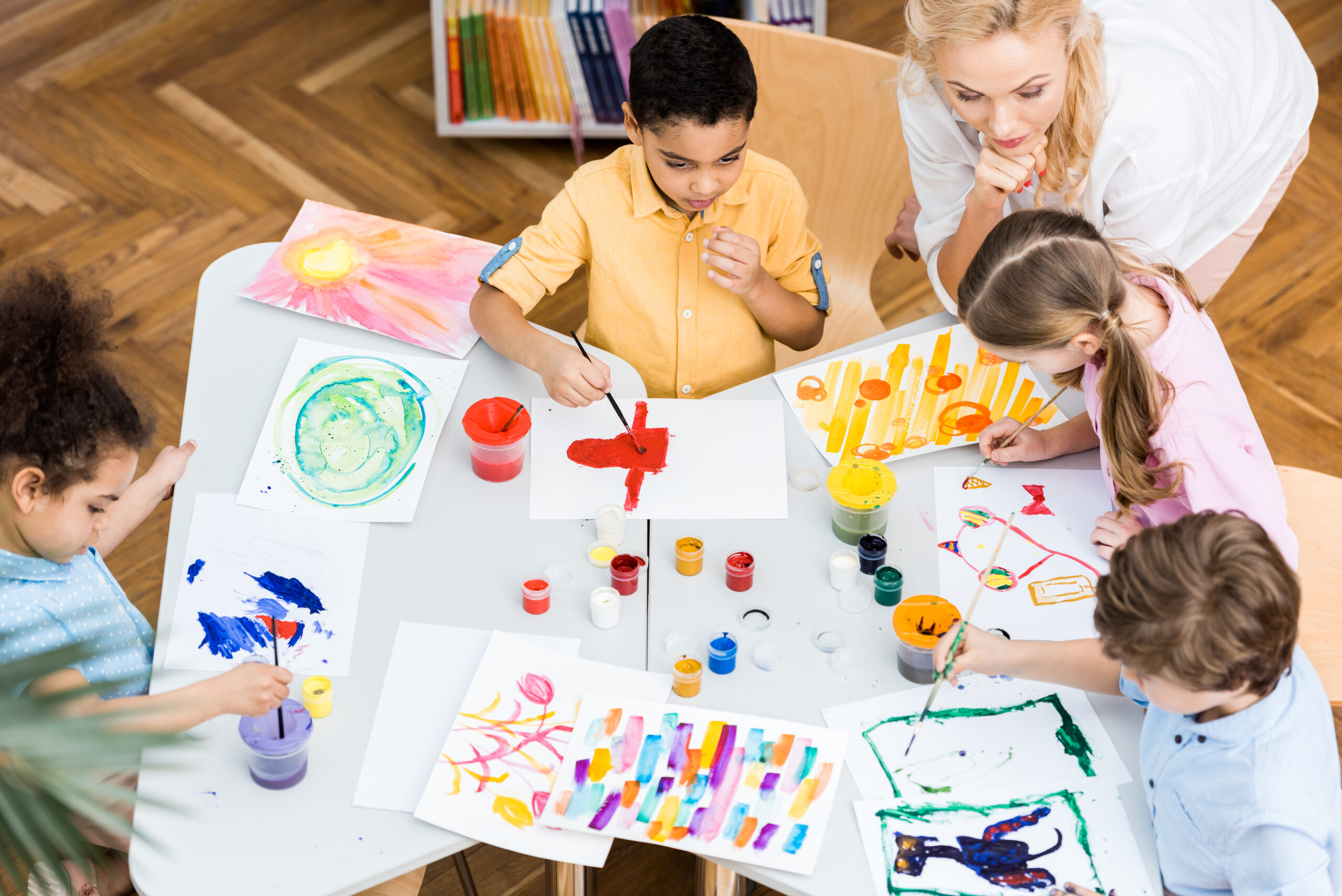
Undoubtedly, arts and crafts are a very efficient way to improve children’s self-expression and creativity. At the same time, doing arts and crafts, kids’ fine motor skills and hand-eye coordination may considerably improve. The main thing one needs to remember when working with crafts is the safety aspect – one should always explain to a child how it should be done. Some craft ideas for kids are the following:
- Drawing or painting
- Making collages out of pictures cut out of magazines
- Creating something with dough or plasticine.
Getting to Know Science and Nature
It is also vital to introduce children to the world of science and nature since it broadens their horizon and opens their eyes. Here are some science and nature ideas for children:
- Creating scientific experiments, for example, building volcanoes
- Observing plants and animals outside
- Building feeders for wild animals
Teaching Independence and Responsibility through Routines
At a certain age, it becomes rather urgent to teach a child to be independent and responsible in order to make sure that he or she grows up into an adult with high moral values. Thus, establishing some routines and giving children a number of tasks may be quite helpful.
Promoting Social Development through Playdates
Undoubtedly, social skills are of high importance as well. Playdates will surely help a child to develop these skills. It would be a good idea to plan the following:
- A playdate with friends
- A meeting with the newcomer from the neighborhood
- An outdoor activity
Conclusion
Creative learning activities play a vital role in supporting the intellectual, social, and emotional development of young children. By combining play, music, reading, arts, nature exploration, and daily routines, parents can create engaging opportunities for growth and discovery. Encouraging curiosity and creativity from an early age helps build confidence, independence, and a lifelong love of learning.